We’ve Seen This Before: The Impact of Crises on Minority Employees
This blog is part of a series exploring strategies through economic turmoil.
In the introduction to this series, Pirical CEO and Founder Jason Ku introduced three things that resilient companies focus on to weather a downturn:
- Relentless focus on customers
- Strategically manage costs and invest for the future
- Get ready to ride the wave of recovery
This article looks at the second theme - strategically manage costs and invest for the future. More specifically, what are the dangers to diversity if not enough care and consideration is given.
“We won’t unlock the full potential of the workplace until we see how far from equality we really are.” — Sheryl Sandberg, COO of Facebook.
Coronavirus has and will continue to have a disproportionately negative effect on BAME employees. COVID-19 is hitting people with diverse ethnic backgrounds especially hard. BME groups make up 1 in 3 of the critical cases (33.3%), even though they only represent 13% of the British population.
On the business side, law firms are, understandably, focusing on ensuring short-term survival and resilience. Many are doing so by furloughing and potentially laying off staff.
However, in the focus to survive, it is important not to unwind years of strides made with diversity.
Recent historic precedents
As unique as the current situation seems, we’ve all seen this before. Similar events unfolded during 2008, as the Global Financial Crisis (GFC) wreaked havoc on economies and societies. Just as it’s playing out now, the brunt of the fallout landed on ethnic minorities.
For starters, ethnic minorities were disproportionately overrepresented in the total number of unemployed. For example, US numbers show that while unemployment rates rose for every group during the GFC, the rates for non-white men rose even higher. In fact, at its peak, white unemployment is only slightly higher than the lowest unemployment rate of Blacks before the GFC started.
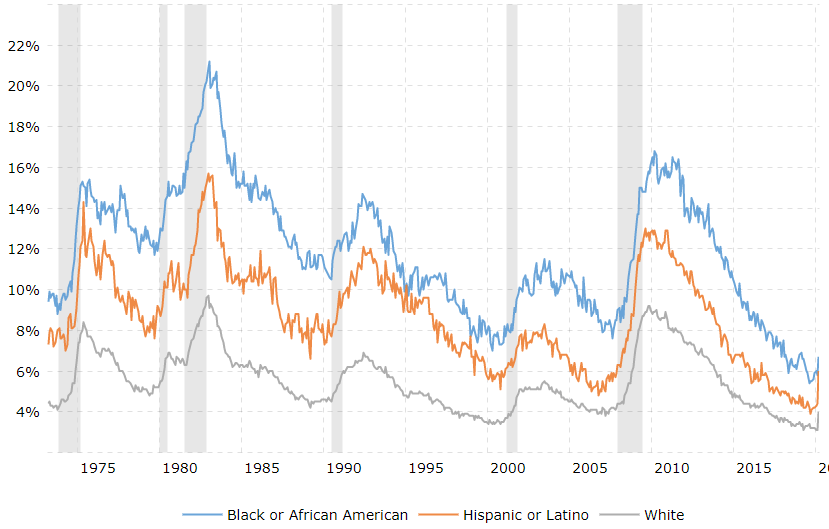
Source: Macrotrends
A long road to recovery
The fallout from recessionary unemployment doesn’t simply go away once the economy corrects course. The impacts on ethnic minority groups are felt long after indicators all start to tick up again.
A study by the Pew Research Center showed that 5 to 6 years AFTER the GFC, median net worth had widened between white households and other groups:
- White households vs black households: 10x before the crisis (2007), 13x after the crisis (2013)
- White households vs hispanic households: 8x before, 10x after
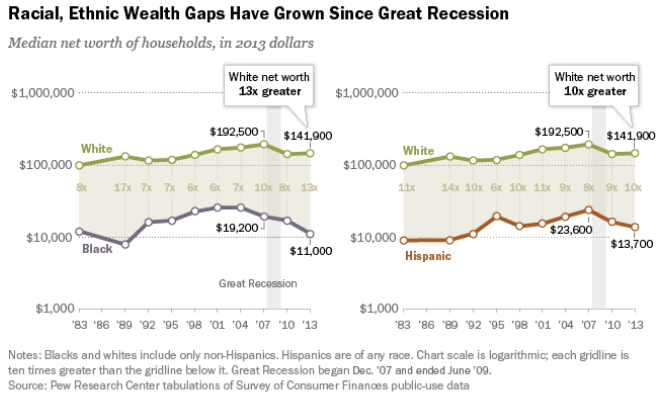
Source: Pew Research Center
What does this mean for diversity?
Here are a few considerations that could potentially have big impacts for diversity over the next few years and potentially over the next generation.
Consideration 1: Impact on school results
In the UK, the rich / poor divide is also more apparent than ever during the crisis, with examples such as:
- A boom in private tuition is helping better-off students continue learning while schools are shut, while those with less money don’t have the same resources.
- Children from lower-income families being disconnected from their classroom during the pandemic, as they don’t have a PC or tablet to access remote learning.
- In the US, disparities in broadband access are highly correlated with ethnicity. A McKinsey analysis found that 21.2% of white households report having either no broadband internet or no computer at home, compared to 36.4% of black households.
- As exams have been cancelled, GCSE and A-level grades will be determined by prediction, with experts saying this will disadvantage minority and working-class students
Invariably, this impact on school-age children and teenagers will continue to ripple into the future and impact their chances to get into and excel in a university setting.
Consideration 2: Impact on University education
Here’s an example of how subtly and gradually people from a low socioeconomic background could be impacted in the context of higher education.
The SAT — a US university entrance exam — can be taken as often as someone wishes, with only the highest result counting.
However, a fee is due for each attempt, which means students from well-off families can sit the exam multiple times to aim for a better result - there is ample evidence that the more you take the test, the better your results. Students from lower-income families may only be able to take it once. And, as this report shows , this is only one way wealthier students hold a significant advantage.
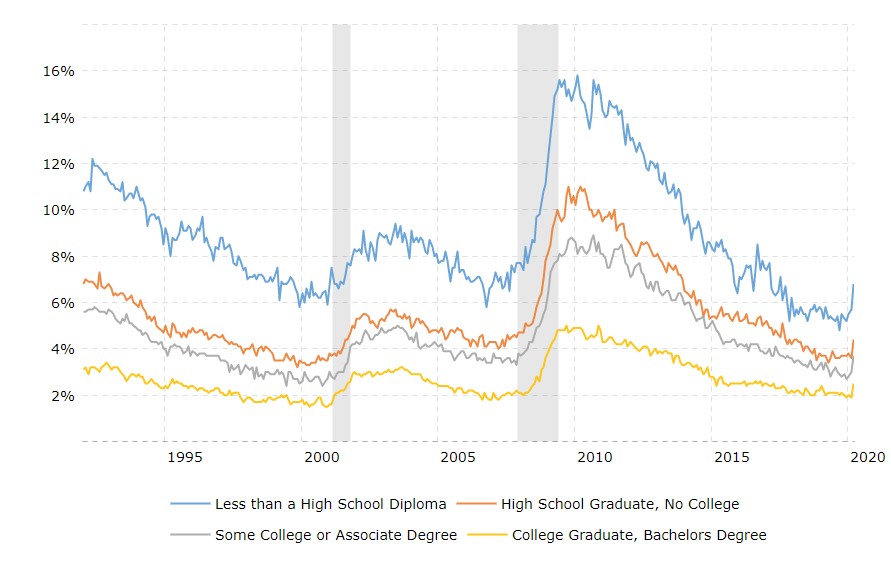
The impact of this is far-reaching: Another recession will come, and when it does, the less educated will be more greatly affected.
Unemployment rate by educational level
Source: Macrotrends
With schools now closed, there are those at risk of never being able to sit the SAT, which negatively impacts their ability to go onto higher education.
Treading carefully
What’s the upshot? Opportunities for diversity and inclusion are always important, but when a crisis hits, they become even more significant because of the stronger impact the event has on minorities. Some are predicting a “V” or “U” shaped recovery, but if a second wave were to hit (the way the 1918 Spanish Flu did), we could see a “W” shaped recovery (a recovery, followed by another sharp drop from a second wave). It is important to carefully consider how things that may seem subtle today, could have big negative impacts several years down the line.
Fast decisions may feel necessary, but they won’t always serve for long-term success and longevity. Before making any moves around diversity, the best course of action may be to review where you stand in this area.
An increasing number of law firms have launched programmes for Year 11 and 12 school students. For example, Clifford Chance is hosting Open Days, one of which is targeted at year 12/13 students. Other programmes aimed at pre-university students can be found here and here . These programmes will likely have a disproportionate benefit for a diverse population.
How Pirical can help
Our BAME Benchmark lets you see in detail where your firm stands on diversity and inclusion initiatives, and where you can focus to alleviate the worst consequences during Covid-19.
Stay up-to-date with the latest market insights and law firm rankings
Subscribe to email updates
Subscribe to content