
A glass of wine and 500 hours surfing POD: 5 key takeaways from our POD Pioneers event
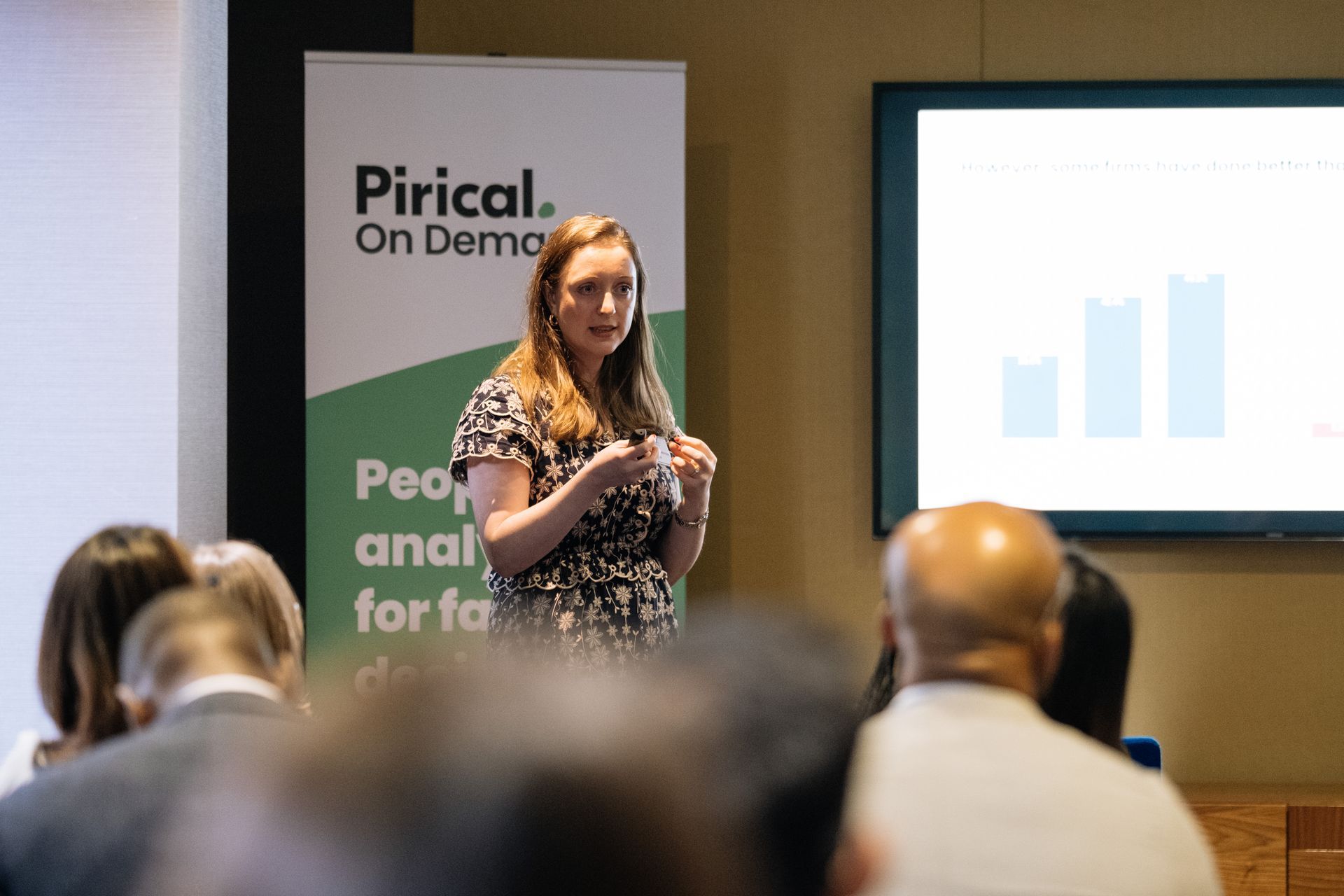
Last week marked the 2nd edition of POD Pioneers, our latest gathering of Pirical On Demand (POD) customers for a day of product updates, networking and plenty of cake. This year we had fascinating sessions on how law firms are using HR and diversity data to effect lasting change, solve complex issues and achieve strategic wins.
Now the dust has settled, we’ve assembled our five key takeaways from the day.
1. Law firms are keener than ever for business leaders and HR Business Partners (HRBPs) to ground their everyday in data
Making data available and actionable to people leaders on the frontlines continues to be a common ambition among law firms. Firms have concluded that hiring ever more analysts to manually crunch numbers in Excel is not a scalable approach. More firms have experimented with business intelligence solutions like custom dashboards (PowerBI, Tableau) or analytics modules within operational systems (e.g. Workday HRIS) and have a more sophisticated understanding of the costs and trade-offs.
One particular shift mentioned at the event is new senior hires coming into law firms from outside the legal sector with higher expectations that data will be at their fingertips and lower appetite to make decisions without data. As a result, teams are being asked to invest in data quality and usability.

2. Showing what’s possible with data will increase appetite for more data
Even if law firm leaders are keen to adopt more data-driven practices, getting buy-in from the wider organisation can be tricky. In one of the discussions, a UK firm discussed their journey towards a more data-driven culture.
With the help of Pirical, the firm conducted a project with two key goals; (1) identify if the firm had an attrition problem in one of their key growth regions and (2) build some internal appetite for further data projects. The team addressed the first goal by identifying a specific problem office in that region and a specific reason employees were leaving. Using data they were able to convey the story of that office to the firm leadership and get real commitment to fix the attrition problem.
The data-driven approach to identifying the source of attrition helped make progress on their second goal, building an awareness of the data capabilities. Our speaker noted that internal stakeholders began to be more curious around this HR data, asking questions like “I didn't know we could provide this, what else can we do?”

3. Spending 500 hours mastering your data will help drive lasting organisational change
“Law firms love evidence”, one speaker pointed out. If you can use data to show the need for strategic and cultural changes, you'll be better able to bring everyone at the firm on board.
If you want to effect lasting change across organisations as large and complex as law firms, having access to data is only half the battle.
You also need to have a deep sense of what your data says. Simply having the numbers in front of you will not address the problems, as one speaker said, "Don’t think of data as the answer, think of it as a way to ask another question.”
"If you're a diversity leader, you can't just rely on a data analyst to summarise what you need to know. You need to have spent the time yourself - I think I've spent like 500 hours in POD or something - getting to grips with our data. What's interesting about it, what I want to look into next etc."
"You could be sitting in front of the telly just POD-surfing. You know, a glass of wine and a bit of POD."

4. Long-term strategic planning doesn’t work without good data
“Law firms are obsessed with other law firms.” This quote from one of our speakers highlights the competitive state of the legal industry. We discussed how understanding your competitors’ growth strategies can be an invaluable asset.
For many people working in this space, gathering named-firm competitor data would usually involve manually looking through websites and 'counting heads' to see where firms have been growing. We discussed Pirical's new legal market intelligence tool, PLP Strategy, which solves this gap in the market.

5. General Counsel (GCs) want law firms to back up their claims of diversity progress with hard data
As well as making plans, another element of using data is looking back to track progress. In one of the case studies presented on the day, we looked at how a law firm used evidence of the organisation’s DEI improvements to stand out from its competitors and build a strong high-trust relationship with a valued client.
In the case study, the client discovered that an underrepresented group had been disproportionately staffed on fixed fee matters with low billing potential. Intricate benchmarking data showed some firms on the client's panel had made more progress than others.
What is Pirical On Demand (POD)?
Pirical's people analytics software equips law firms with the HR, rewards and diversity data they need to make smarter and fairer people decisions.
HR data is messy, hard to analyze and difficult to distribute to people leaders. With Pirical On Demand, it's a lot easier for people leaders to get value out of it, without the need for an army of analysts and engineers. With Pirical, you can save time, get people engaged and take a more sophisticated, data-driven approach.
Stay up-to-date with the latest market insights and law firm rankings
Subscribe to email updates
Subscribe to content