How to boost Inclusion of BAME lawyers - add this one ingredient
The share of lawyers of Black, Asian and Mixed Ethnicity (BAME) in the legal profession has been steadily growing over the past few years, reaching numbers that surpass national averages within the UK workforce.
The latest figures by the SRA, collected in August 2017, show that 21% of lawyers are BAME, almost double the national average of 11% (= share of BAME across the entire UK workforce). This is largely driven by Asian lawyers (14%). Black and Mixed Ethnicity lawyers represent 3% and 4%, respectively.
Specific policies and their impact on BAME inclusion
These numbers represent the ‘Diversity’ part of ‘Diversity and Inclusion’. While it is helpful to know how diverse your workforce is (% of staff that is BAME), it is equally important to know how your diverse workforce is thriving. Are there policies or practices that hinder the development of BAME lawyers’ careers?
Over the last few years, we at Pirical have been working with law firms who have asked us to look deeper into their HR practices to identify which topics help or hinder the advancement of BAME professionals. We will share one interesting finding.
The impact of Resource Management on Inclusion
The more time a lawyer spends serving clients on matters, the better. No one is served by sitting “on the bench” - i.e. being between assignments.
We analysed the average number of matters each ethnic group worked on per year and found that BAME associates worked on 25-33% fewer matters per year than their Non-BAME counterparts. There could be an innocent explanation for this: we know that diversity rates are not the same across practice areas, and perhaps BAME associates may be more concentrated in practice areas where fee-earners worked on fewer matters, but each was longer. If this were true, then we would expect their utilisation rates and total billed hours to be equal. Unfortunately, when we controlled for this, the results held — utilisation was indeed lower for BAME associates.
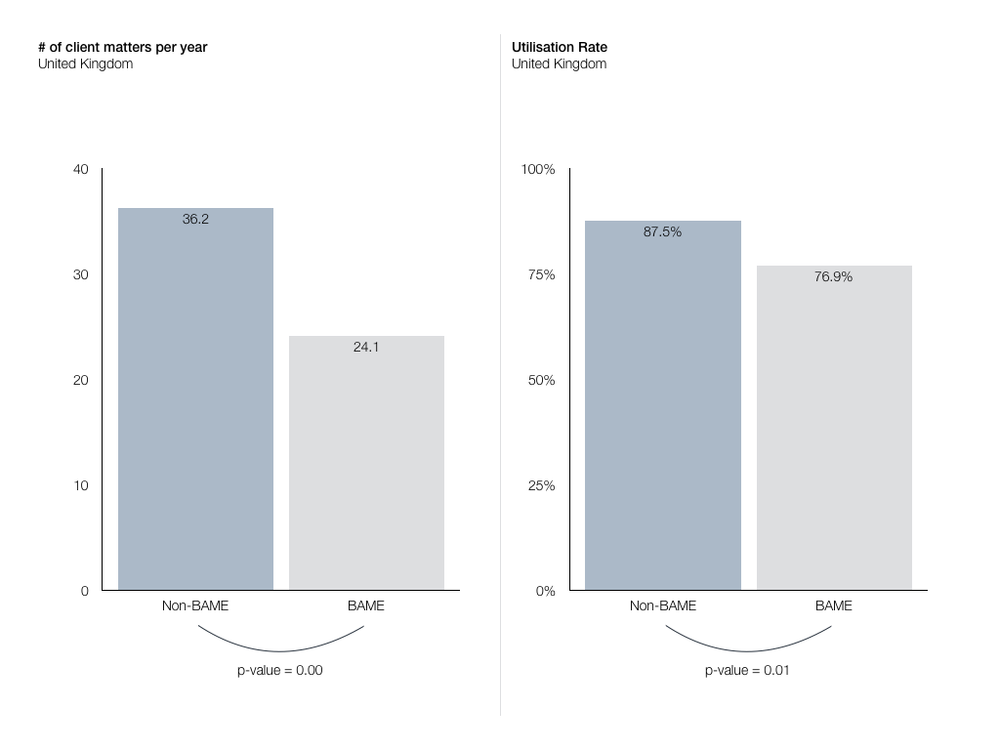
BAME lawyers work on fewer client matters per year and have a lower utilisation rate.
However, the picture changed for BAME associates when Resource Management was introduced. Many firms have been hiring Resource Managers to help allocate associates to client matters. Since Resource Managers are rolled out progressively, there will inevitably be parts of the firm that have Resource Managers, and other parts that do not. If Resource Management has an effect on inclusion, then we would expect the number of matters BAME associates worked on per year to increase with the introduction of Resource Management.
Sure enough, this is what the numbers say — for BAME associates in practice areas with Resource Managers, the number of client matters they worked on was 24% higher compared to BAME associates in practice areas without Resource Managers.
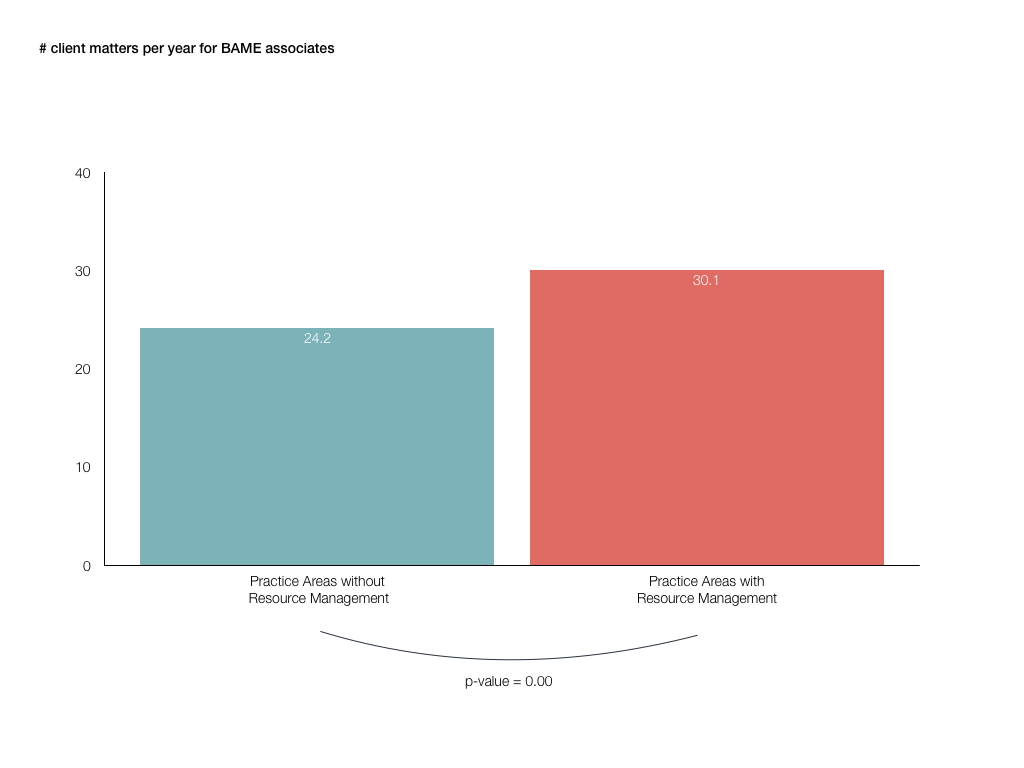
We don’t have a strong hypothesis on why Resource Management reduces the problem. It could be that partners who staff their own teams allows bias to take a stronger foothold, and can be reduced if you introduce an intermediary who has a more detached relationship with the people they are about to staff. It could be that Resource Managers have a mandate for Inclusion, and is making a difference.
Be it as it may, introducing Resource Management is correlated with higher utilisation of BAME associates.
Do you want to run the numbers on BAME Diversity and Inclusion in your law firm? Contact us for a free, zero-obligation initial consultation.
Stay up-to-date with the latest market insights and law firm rankings
Subscribe to email updates
Subscribe to content