Getting to the bottom of black lawyers at the top
Partners at law firms respond well to hard statistics. That’s one thing I’ve learned in five years of analysing their HR data. While they may not be maths geeks, they are certainly critical thinkers. They love to see messy, intractable, everyone-has-an-opinion issues broken down into simple questions that can be tested using data:
- Do we have a problem with X? Yes or no
- Which of these possible factors are driving the problem?
- Will we make more of a dent by focusing on A or B?
Not many people realise how much we can do with their HR data, particularly when it’s linked with their historic matters and billing records.
We have previously helped clients discover that BAME associates found themselves as the only minority fee earner on a project team seven times more often than if work allocation was random.
The firm was using them tokenistically to add ‘diversity’ to every team, meaning the experience of these associates was that they were always surrounded by White people. (Incidentally, algorithmic resource managers solve this problem entirely).
My favourite insight from recent projects has been to identify which of the firm’s major clients were a bad influence on the attrition of their diverse staff members!
Benchmarking law firms
But as the questions become less about the firm and more about the whole industry, the more we butt up against the limits of what we can answer using data from one organisation. Our customers need more context to know whether they are doing well or badly. They need to know where they are relative to competitors.
For no issue is this more true than for ethnic diversity. Barriers facing black, Asian and mixed ethnicity legal professionals transcend firms and, while no single organisation expects to solve them alone, firms are coming to realise that without each other’s help they may not even be able to detect them.
In a recent interview on the subject, Segun Osuntokun of Bryan Cave Leighton Paisner mused that if you were to ask fish about the kind of water they were in they would likely respond “What the hell is water?” In other words, some things are so pervasive that they are barely detectable at an individual level.
Aggregating data from across the market, Pirical’s BAME Benchmark product looks at why ethnic diversity in law firms declines with seniority. Or – to be more human about it – why some people face barriers to entry and progression based on the colour of their skin.
We’re already working with two dozen major UK, US and international law firms to pool and benchmark their ethnicity data, analysing biases in recruitment, performance, retention and promotions to show firms whether they are laggards or leaders in each, and to help them make decisions about what to do about it. The data is regularly refreshed, so firms can track progress over time.
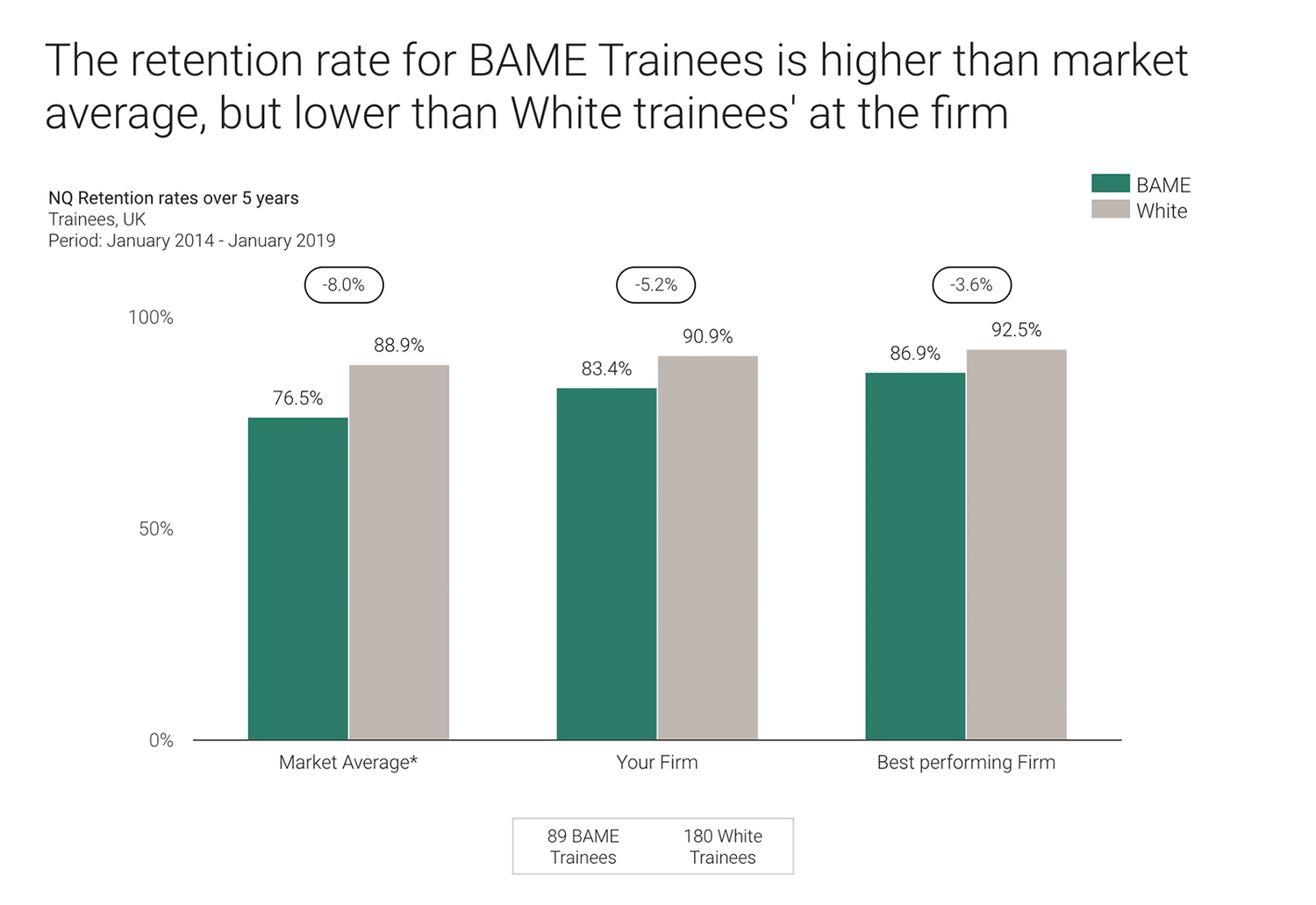
‘The retention rate for BAME trainees is higher than market average, but lower than White trainees' at the firm.’ Fictional data for illustration only.
We have discovered many surprising trends for participating firms, and sparked collaborative action at the highest levels of their partnerships.
I’m proud that we have supported nine of the top 50 firms to assess their progress, define key firm metrics, and set realistic targets for the future, based on the state of the industry.
What’s coming next?
Interest in our ethnic diversity products has rocketed in recent months. Partly because of changing social attitudes, and partly because we’ve built enough technology to handle this kind of data collaboration at scale, and in a way that’s accessible for all shapes and sizes of firm.
We are particularly proud of our recent engagements with smaller firms that have no existing HR analytics capacity, and relatively less data.
Looking ahead, it might give you a flavour of what’s coming around the corner to know I spend as much time talking to general counsel about the diversity of their panel firms as I do talking to regulators and NGOs about what ‘good’ could look like across the industry.
I’m not a betting man but I do work in probabilities: I’d say it’s very likely that transparency around ethnic diversity will be a defining feature of UK legal practice management for many years to come.
Stay up-to-date with the latest market insights and law firm rankings
Subscribe to email updates
Subscribe to content