Which Law Firms Are Powering The Data Centre Boom? The 2026 Update
When we last ran these numbers in February, the data centre story was still mostly a story about money. It isn't any more.
Since then the fight has moved to town halls and primary ballots. Law360 spent August examining how community opposition is reshaping lender behaviour, and Norton Rose Fulbright's Ammad Waheed told reporter Keith Goldberg where that leaves developers: "It's really become a project delivery risk, and therefore it's a credit risk." Moratoriums, permitting fights and power scrutiny have all landed on the same desks. Which is one reason the legal talent market has kept accelerating rather than cooling.
We've rerun our February rankings with data through 3 September 2026, and added something new: a look at which firms are actually being instructed by the companies doing the building.
Hiring Is Running 21% Ahead of Last Year's Record
2025 was the year data centre lateral hiring broke out, up 65% on 2024. 2026 is on course to beat it.
AM Law 200 firms made 191 lateral Partner hires with data centre experience in the first eight months of the year. At that pace the full year lands around 283, roughly 21% above 2025 and more than triple the 2020 figure.
Law360 framed the current market in September as an ongoing front in legal talent battles, which is about right. The interesting detail sits in the exits column.
Baker Botts Leads on Commitment, But the Net Numbers Tell a Different Story
Measured as a share of all lateral Partner hires, Baker Botts tops the table at 21%, followed by O'Melveny & Myers (19.3%) and Winstead (19%).
A firm can hire heavily and still end up roughly where it started, so the exits column is worth reading alongside. O'Melveny has brought in 21 data centre Partners since 2020 and lost one, for a net gain of 20, the strongest retention record in the top ten. Gibson Dunn is close behind at +18 and Simpson Thacher at +16.
Compare that with White & Case, which has hired 33 and lost 35. Vinson & Elkins sits at minus five despite an energy practice sitting right on top of this work. Greenberg Traurig has the largest net gain anywhere in the table at +45, from 53 hires and only eight departures.
Benesch, which we featured in February, has lost nobody at all. Eleven hires, zero exits.
Greenberg Traurig Has Overtaken Latham & Watkins
Kirkland & Ellis still leads on bench depth, and the gap has widened rather than closed. The firm now has 257 Partners with data centre experience, up from just under 250 in January. Dentons holds second at 202.
The notable move is third place. In February we reported Latham & Watkins on 110 and Greenberg Traurig on 101. Greenberg Traurig now sits at 127 against Latham's 125, having added 26 Partners to Latham's 15. DLA Piper has gone from 100 to 120.
Below them, Simpson Thacher (114), White & Case (109) and Sidley Austin (105) have all pushed past the hundred mark since we last looked.
Texas Is Where The Hiring Went
Houston has added 20 data centre Partner hires so far in 2026, matching Washington DC and second only to New York City's 40. That takes it to 55 since 2020, past Chicago on 51 and Dallas on 48. Add Dallas in and Texas accounts for 103 hires, running close behind London's 110.
New York City remains well clear on 171, with London and DC on 110 and 105.
We called Chicago a rising tier one market in February. It has added eight hires since. The energy work went south instead.
Worth noting that Ammad Waheed, the Law360 source quoted above, runs Norton Rose Fulbright's Houston real estate practice and appears in our matters data on CoreWeave data centre leases valued above $15bn. The commentary and the hiring are coming from the same place.
New This Time: Who Is Doing the Work
A big bench only shows what a firm has put in place. Whether the work actually arrived is a separate question, and the matters are where you find out.
So we picked eight companies, two from each layer of the data centre economy, and counted publicly disclosed matters.
On the demand side we took Oracle and CoreWeave. Oracle is the fifth of the big spenders and uses a noticeably different set of outside counsel from Google, Meta, Microsoft and Amazon. CoreWeave stands in for the neoclouds, and its IPO and debt financings have left a dense, recent matter trail.
For digital infrastructure we took Equinix and Vantage Data Centers, which operate on different models. Equinix is listed and acquisitive, generating a steady run of M&A, joint venture and financing work. Vantage builds to order for single tenants and is privately held, so its legal work leans towards development and project finance rather than leasing.
Power is where we expected the real story. Availability of electricity now decides whether a project gets built at all, and the nuclear power purchase agreements Constellation Energy has signed are novel enough that the counsel choices should tell us something. Talen Energy sits alongside it as the merchant comparison.
That leaves equipment and cooling. Vertiv does almost nothing except cooling and power infrastructure, which makes it easy to read. Eaton is far more diversified but supplies electrical equipment at the scale these sites need.
We left out general contractors, which do enormous volume but generate little publicly disclosed legal work. We also left out Nvidia, since it sells into the buildout rather than commissioning it, which makes it a different story.
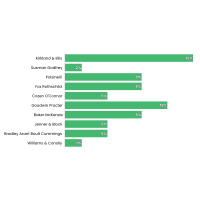
Kirkland & Ellis leads here too, and not narrowly. The firm has 92 publicly disclosed matters across seven of the eight companies, using 79 lawyers. Davis Polk is second on 30, Orrick third on 29.
Orrick is the outlier worth flagging. It appears nowhere in our hiring or bench rankings, yet sits third on matters, and 26 of its 29 come from Oracle alone. That is what a deep single-client relationship looks like in the data.
The power segment came back rich rather than sparse, but it didn't hand the work to a separate cast of energy regulatory specialists. Kirkland's Houston bench has it. Equipment is the genuine contrast: Eaton's panel runs through Covington & Burling (13 matters), Paul Weiss (11), Skadden (11) and Jones Day (9), firms whose data centre profile barely registers in the hiring tables.
Four matters give a sense of the range.
Constellation Energy's $26.6bn acquisition of Calpine in January 2026 is the largest in the set, with Kirkland fielding a cross-practice team out of Houston, New York, Austin and Dallas.
Talen Energy's $20bn power purchase agreement with Amazon Web Services is the most structurally interesting. Vinson & Elkins led on the 1,920 MW deal, with Kaam Sahely on project development across Austin and New York.
Eaton's $9.5bn acquisition of Boyd Thermal from Goldman Sachs in March 2026 shows cooling becoming a strategic asset class in its own right. Paul Weiss ran it from New York.
CoreWeave's $9bn all-stock acquisition of Core Scientific in July 2025 pulled in one of the widest Kirkland teams in the dataset, spanning M&A, tax, regulatory, environment and real estate finance out of Dallas, Houston and Chicago.
Note on methodology
'Data Center Partners' are Partners with references to Data Center experience in their professional bios and previous matters worked.
Matter rankings cover publicly disclosed matters handled for Oracle, CoreWeave, Eaton, Equinix, Talen Energy, Constellation Energy, Vantage Data Centers and Vertiv.
Source: Publicly-available data tracked by Pirical Legal Professionals
Timeframe: Jan 2020 to 3 September 2026
Explore For Yourself
Book a demo to explore how you and your team could utilise this data
Pirical Legal Professionals seamlessly aggregates data from a wide range of public sources: law firm websites, bar associations, legal news, deals publications, legal rankings, LinkedIn and more. Our coverage is global, in-depth and constantly refreshed.
Stay up-to-date with the latest market insights and law firm rankings
Subscribe to email updates
Subscribe to content