Big Law's Tariff Litigation Power Rankings: Exclusive Analysis Reveals Market Leaders in Massive Refund Battle
A landmark Supreme Court decision just invalidated presidential tariff authority. Big Law firms are now racing to capture what could become one of the most lucrative litigation waves in recent memory.
More than 2,000 refund lawsuits have already been filed. The stakes exceed $100 billion in potentially recoverable duties. An exclusive analysis by Pirical identifies which law firms are best positioned to capitalize on the tariff litigation boom. The analysis weighs three factors: client representation, practice investment, and specialized expertise.
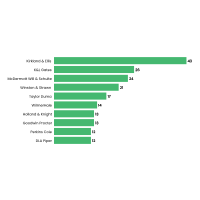
Kirkland & Ellis emerges as the clear market leader. The firm represents 12 major companies seeking tariff refunds. That's double the client count of its nearest competitor. Kirkland's 74.8 composite score in Pirical's three-pillar analysis significantly outpaces Akin Gump (58.9) and Latham & Watkins (51.3), which round out the top three.
The Litigation Landscape
The surge in tariff cases follows the U.S. Supreme Court's February 2026 ruling. The court found the Trump administration lacked statutory authority to impose sweeping global tariffs under the International Emergency Economic Powers Act. Courts invalidated duties that generated more than $170 billion in government revenue. This created an unprecedented refund scenario.
Companies ranging from FedEx and Costco to Lululemon, Dyson, and Dollar General have filed suit. They want reimbursement from the U.S. Court of International Trade. Court filing analysis shows Crowell & Moring filed approximately 200 cases, the highest volume. Sidley Austin filed approximately 160 cases. But case count alone doesn't determine market leadership.
Methodology: Three Pillars of Tariff Excellence
Pirical's ranking methodology weighs three distinct measures of law firm capability in tariff litigation.
Pillar 1: Client Representation in Tariff Lawsuits (40% weight)
Measures actual representation of 15 major companies filing Trump-era tariff refund suits. The companies include publicly traded corporations and household-name brands. Data comes from court filings and public disclosures.
Pillar 2: International Trade Practice Strength (35% weight)
Combines two sub-metrics. The first is starting headcount in international trade practices as of February 2023 (60% of pillar score). The second is growth rate through February 2026 (40% of pillar score). The approach rewards both established scale and strategic investment in trade capabilities.
Pillar 3: Overall Trade & Government Work Profile (25% weight)
Measures breadth of public trade and government-related legal matters across all practice areas. It demonstrates institutional expertise beyond tariff litigation alone.
Scores were normalized to a 100-point scale within each pillar, then weighted to produce composite rankings.
The Top Tier: Elite Performers
Tier 1 - Market Leader (70+ composite score)
Tier 2 - Premier Practices (50-69 composite score)
Tier 3 - Strong Capabilities (40-49 composite score)
The Middle Pack: Established Players
Tier 4 - Solid Capabilities (30-39 composite score)
Tier 5 - Emerging/Specialized (Under 30 composite score)
On the 21st-25th Ranked Firms: Steptoe has four clients and a stable 19-lawyer practice. Cooley has six clients only. Gibson has five clients only. Wiley shows infrastructure only with 16 lawyers and 25% growth. Skadden has four clients only.
Strategic Archetypes: Different Paths to Tariff Market Position
The pillar-by-pillar analysis reveals distinct strategic approaches. The composite ranking alone obscures these differences.
The Infrastructure Giants (High Pillar 2, Low Pillar 1)
Baker McKenzie,
Hogan Lovells, and
Wiley Rein have built or maintained substantial trade practices. These range from 16 to 43 lawyers. Yet they show minimal to zero visible tariff client representation. These firms either serve clients not captured in public data, or they focus on non-litigation trade work. Or they're banking that infrastructure precedes business development in emerging practice areas. The approach represents a long-term bet. When tariff litigation expands or evolves, these firms will have ready capacity.
The Client Capture Specialists (High Pillar 1, Low Pillar 2)
Morgan Lewis,
McGuireWoods,
Morrison & Foerster, and
DLA Piper have significant client rosters (7-9 companies) despite lean or invisible practice infrastructure. This suggests several possibilities. The firms may have exceptional expertise allowing small teams to punch above their weight. Or they may have pre-existing client relationships from other practice areas. Or they pursued aggressive business development. The approach maximizes current revenue but may face scalability challenges if litigation volume surges.
The Balanced Competitors (Moderate across all pillars)
Kirkland,
Covington, and
Mayer Brown show strength across multiple dimensions without dominating any single category. This diversified profile likely indicates sustainable, institutionalized practices. These firms don't rely on individual rainmakers or temporary market positioning.
The Trade Powerhouses Without Tariff Focus (High Pillar 3, Low Pillar 1)
Paul Weiss (51 trade matters),
Cleary Gottlieb (29 matters),
Jones Day (26 matters), and
Weil (22 matters) demonstrate substantial government and trade work. But they have limited tariff refund client visibility. These firms may specialize in regulatory work, trade policy, or government investigations rather than tariff litigation. Or their tariff work may involve smaller companies or confidential matters not tracked in public filings.
The Growth Stories (High Pillar 2 growth rates)
WilmerHale (62% growth),
King & Spalding (47% growth),
Covington (44% growth), and
Akin Gump (45% growth) combine rapid practice expansion with emerging or established client work. These firms are making explicit strategic bets. They believe tariff and trade litigation represents a long-term growth area worth significant investment.
The Road Ahead
Key procedural questions remain unresolved following the Supreme Court decision. Courts must still determine how refunds will be administered. They must decide whether relief applies broadly across similar claims. And they must set the timeline for repayment. The U.S. Court of International Trade is considering streamlined approaches to manage the massive caseload.
Many companies are filing lawsuits as a protective measure. Administrative refund processes through U.S. Customs and Border Protection remain unclear. One company reported filing costs between $20,000 and $30,000. The company views litigation as insurance against potentially missing refunds.
The Justice Department has indicated the refund process will take time. The department cited precedent from 1998 harbor maintenance tax cases that required seven years to resolve. But those cases involved far smaller sums.
The firms that have built both client relationships and practice infrastructure appear best positioned to sustain long-term market leadership. This has rapidly become one of Big Law's most significant new practice drivers. Yet the pillar-specific analysis reveals no single winning formula. Firms are placing distinct bets on client acquisition versus capacity building. They're choosing between immediate revenue versus long-term positioning. And they're deciding between litigation versus broader trade work.
The ultimate winners may depend less on current positioning than on how tariff litigation evolves. Will it remain concentrated among major corporations? Will it expand to mid-market importers? Will it shift toward class-action structures? Or will it transform into administrative refund processing that requires different expertise entirely? The answers will determine which strategic bets pay off.
Note on methodology
Source: Publicly-available data tracked by Pirical Legal Professionals (PLP)
Firm rankings based on proprietary Pirical PLP analysis combining public court filings, disclosed client representations, and lawyer headcount data from February 2023 to February 2026 across Am Law 200 firms. Composite scores weight client representation (40%), practice infrastructure and growth (35%), and overall trade and government work profile (25%).
Analysis powered by Pirical Legal Professionals (PLP)
Pirical Legal Professionals is the largest attorney database built with the most comprehensive data on the market. Specifically designed for legal recruitment and legal market research. It is used by over 100 law firms worldwide including 75% of the AM Law 20 and 80% of the UK top 50 law firms.
Pirical seamlessly aggregates data from a wide range of public sources, tracking over 700,000 attorney profiles worldwide. Our data helps law firms source lateral talent quicker, identify candidates with key client relationships, map competitor firm strategies & team structures, and much more.
Stay up-to-date with the latest market insights and law firm rankings
Subscribe to email updates
Subscribe to content